

French Drain Installation and Repair Services in Madison & the Greater Jackson, MS Metro Area
French drains are among the most effective engineered drainage solutions for managing both surface and subsurface water while protecting landscapes, foundations, and structures. In Mississippi, heavy rainfall combined with clay-rich soils limits natural infiltration, often leading to standing water, erosion, and moisture-related damage when water is not properly intercepted and redirected.
Our French drain systems are engineered as part of a comprehensive water management strategy designed to control groundwater movement below grade while supporting coordinated surface drainage above. Using gravity-driven flow, these systems collect excess subsurface moisture through a gravel-filled trench and perforated pipe, then convey it safely to designated discharge points. When appropriate, French drains are integrated with surface features such as dry creeks, swales, catch basins, or culverts to create a unified drainage network that manages water efficiently and predictably across the property.
Madison Elite Irrigation
provides professional French drain installation, repair, and consultation services for residential and light commercial properties throughout
Madison,
Ridgeland,
Flowood,
Brandon,
Gluckstadt, and the surrounding Greater Jackson, MS metro area. Each system is carefully planned to ensure proper depth, slope, material selection, and long-term performance while preserving the stability, health, and visual integrity of the surrounding landscape.
Understanding French Drains & Water Flow Management
A French drain is a surface or subsurface drainage system engineered to collect and redirect excess water away from problem areas. It typically consists of a gravel-filled trench containing a perforated pipe that intercepts water and conveys it to a designated discharge point.
French drains are commonly used to:
- Relieve water buildup around foundations and structures
- Eliminate standing water in low-lying or poorly draining areas
- Reduce soil saturation and erosion caused by excess moisture
- Support long-term landscape stability and structural health
Proper design, slope, and placement are critical to long-term performance—particularly in Central Mississippi’s clay-heavy soil conditions.
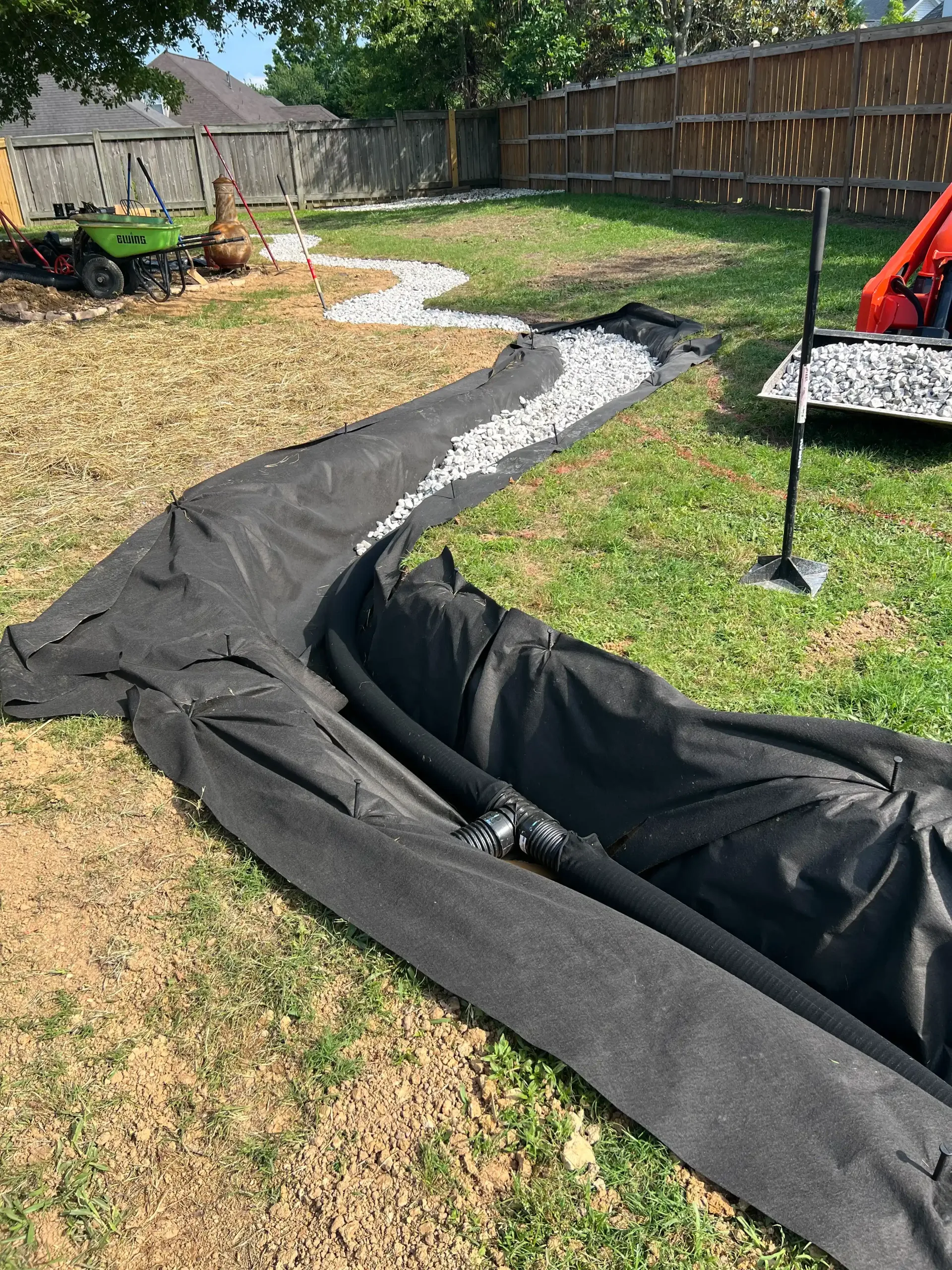
Open vs. Closed French Drain Systems
Closed French Drains (Subsurface Applications)
Closed French drains are installed below ground and are designed to manage subsurface water. These systems are commonly used near foundations, basements, crawl spaces, and areas where groundwater pressure causes persistent saturation.
Benefits of closed French drains include:
- Hidden installation with minimal visual impact
- Long-term groundwater control
- Protection for foundations and structures
- Low maintenance when properly installed
Closed systems are ideal where water issues are not visible on the surface but cause long-term moisture problems.
Open French Drains (Surface and Subsurface Water Management)
Open French drains are designed to manage surface runoff and visible water flow. These systems may incorporate gravel, stone, or decorative elements and are often used in conjunction with landscape features.
Open French drains are commonly used to:
- Capture surface runoff during heavy rainfall
- Reduce erosion along slopes
- Transition water toward dry creeks, swales, or discharge areas
- Blend drainage function with landscape aesthetics
When appropriate,
open drainage systems are
strategically integrated into the landscape
to deliver dependable, high-performance surface water control. In Central Mississippi’s clay-heavy soils, deep open French drains are a proven, engineered solution for efficiently capturing and conveying surface and subsurface water away from vulnerable areas.
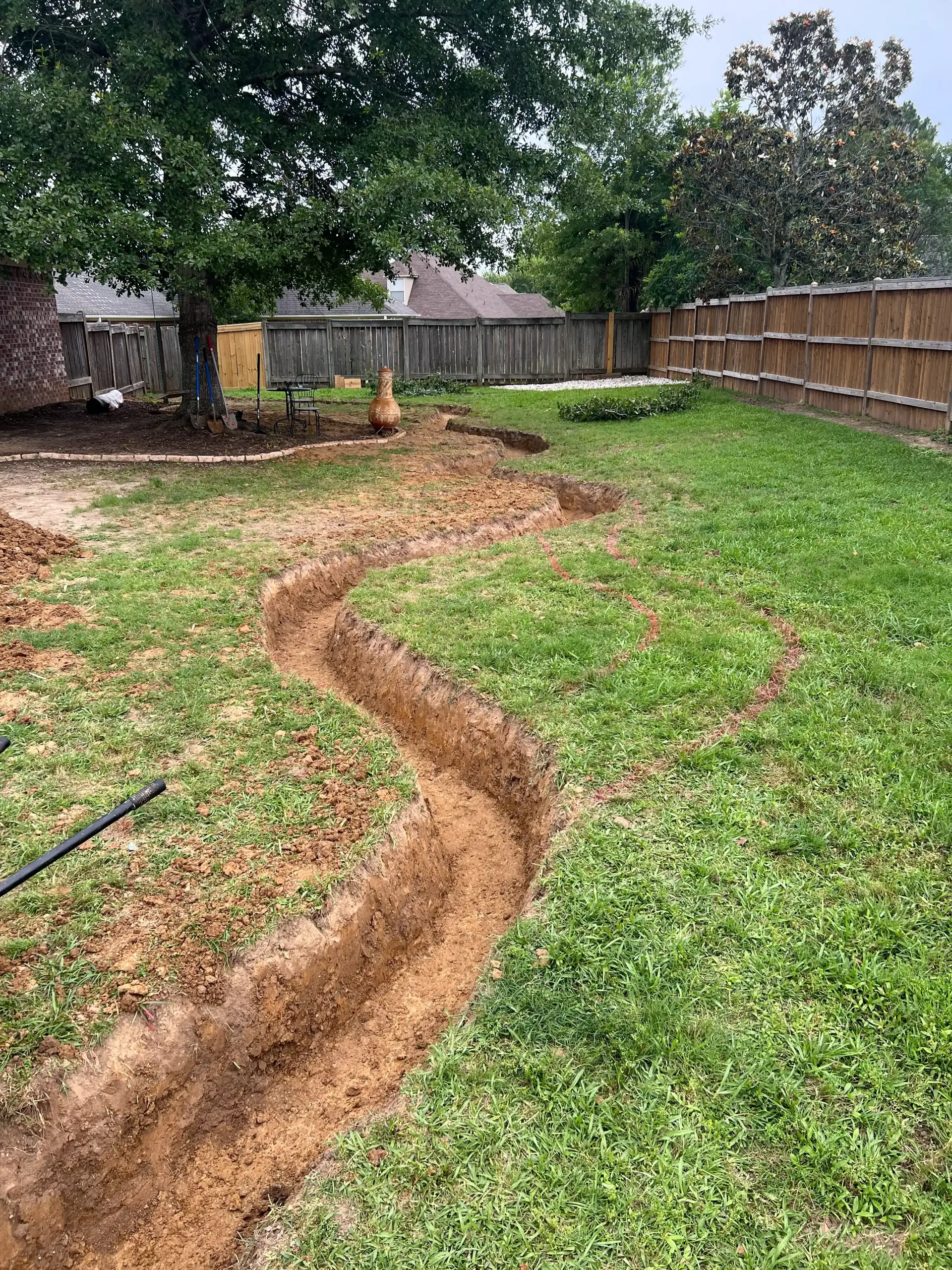
How French Drains Work (Technical Overview)
French drains function by intercepting, collecting, and conveying excess water away from problem areas using gravity-driven flow. When properly designed, they relieve hydrostatic pressure in saturated soils and prevent water from accumulating near foundations, landscapes, and hardscape features.
System Components and Function
- Perforated Pipe: Installed at a calculated depth and slope, the pipe allows subsurface water to enter through perforations and flow toward a designated discharge point.
- Gravel Envelope: Clean, angular stone surrounds the pipe, creating void space that promotes rapid water collection while preventing soil intrusion.
- Filter Fabric (when required): Separates surrounding soil from the gravel envelope to reduce clogging and maintain long-term system efficiency.
- Positive Slope and Discharge: The system is graded to ensure consistent downhill flow, directing collected water to daylight, a dry creek, swale, catch basin, or other approved outlet.
How the System Manages Water
As water moves through saturated soil, it naturally follows the path of least resistance into the gravel-filled trench. The gravel reduces soil pressure and allows water to flow freely into the perforated pipe, where it is safely conveyed away from vulnerable areas. When integrated with surface drainage elements, French drains transition subsurface water into controlled surface conveyance for efficient discharge.
Why Design Matters
Proper depth, slope, pipe placement, and
integration with other drainage systems
are critical to performance—especially in Central Mississippi’s clay-heavy soils, where poor infiltration and prolonged saturation are common. A correctly engineered French drain provides long-term moisture control, protects structural integrity, and supports overall landscape health.
Why French Drains Matter in Madison, MS
Madison and the surrounding Jackson metro area experience frequent heavy rainfall combined with clay-heavy soils that limit natural drainage. Without proper water management, excess moisture can lead to:
- Foundation damage
- Soil erosion
- Landscape failure
- Mold and moisture intrusion
French drains play a critical role in protecting properties from these issues when properly designed and installed.
Why Choose Our French Drain Services
Our French drain solutions are part of a comprehensive approach to drainage and water management. We focus on:
- Accurate site evaluation
- Customized system design
- High-quality materials
- Proper installation techniques
- Long-term performance, not temporary fixes
By addressing the cause of water problems — not just the symptoms — we deliver drainage solutions you can rely on.
Request a French Drain Consultation
If you’re experiencing standing water, surface pooling, saturated soil, or recurring drainage problems around your home or landscape, a professional evaluation is the first step toward determining whether a French drain is an appropriate solution. These issues are often caused by a combination of poor subsurface drainage, limited soil infiltration, surface runoff concentrating in low areas, or water collecting where it cannot drain naturally.
A French drain evaluation allows us to assess how water moves across and below the surface of your property during rainfall events. By examining surface flow patterns, soil conditions, grading, and existing drainage components, we can determine whether a properly designed French drain system can effectively intercept and redirect excess water away from structures and landscaped areas. Addressing these conditions early helps reduce surface pooling, relieve soil saturation, protect foundations and hardscapes, and preserve the long-term usability of your outdoor space.
Call today to schedule a French drain consultation and discuss site-specific drainage solutions with a knowledgeable professional serving Madison and the Greater Jackson metro area.
Frequently Asked Questions About French Drain Installation
🔸 What is a French drain and how does it work?
A French drain is a drainage system designed to collect and redirect excess groundwater or surface water away from problem areas. It typically consists of a gravel-filled trench containing a perforated pipe that allows water to enter the system and flow toward a designated discharge point, helping protect foundations, low-lying areas, and vulnerable landscape features.
🔸 What is the difference between an open and closed French drain?
Closed French drains are installed below ground and are commonly used to manage subsurface water near foundations or persistently saturated soil areas.
Open French drains are designed to manage surface water and may incorporate decorative stone, allowing them to function as both a drainage solution and a visible landscape feature. The appropriate design depends on water flow patterns, grading, and site conditions.
🔸 How do I know if I need a French drain?
Common indicators include standing water after rainfall, soggy or compacted soil, erosion, water collecting near foundations, or recurring drainage issues in low-lying areas. Properties in Madison, MS often experience these conditions due to clay-heavy soils and periods of heavy rainfall.
🔸 Can French drains handle heavy rainfall?
When properly designed with correct slope, placement, and discharge routing, French drains are highly effective at managing heavy rainfall by intercepting water and directing it away from problem areas before damage occurs.
🔸 How long does French drain installation take?
Many French drain installations are completed within one to three days, depending on system length, site conditions, and whether the drain is open or closed. Larger or more complex installations may require additional time to ensure proper performance.
🔸 Will installing a French drain damage my landscaping?
Installation requires excavation, but work is carefully planned to minimize disruption. Trenches are precisely excavated, and disturbed areas are restored after installation. When applicable, open French drains can be integrated as decorative landscape elements.
🔸 How much maintenance does a French drain require?
French drains are generally low-maintenance systems. Periodic inspection of outlets and surface components is recommended to ensure water flows freely. Proper installation helps reduce the risk of clogs or long-term performance issues.
🔸 Are French drains a long-term solution?
When installed using proper grading, appropriate materials, and correct discharge design, French drains provide a durable solution for managing excess water and protecting soil stability, structures, and surrounding landscaping over time.
🔸 Do you offer French drain installation throughout the Jackson area?
Yes. We provide French drain design and installation services throughout Madison, MS, as well as Ridgeland, Flowood, Brandon, Gluckstadt, and the Greater Jackson, MS metro area.
🔸 How do I get an estimate for a French drain installation?
The first step is a professional site evaluation. We assess drainage conditions, water flow patterns, and grading, then recommend a French drain solution tailored to your property and water management needs.
🔸 How do I get an estimate for a drainage system?
The first step is a professional site evaluation. We assess drainage conditions, water flow patterns, and property characteristics, then recommend a customized water management solution based on the findings.